
Five Years After Winter Storm Uri in Texas: Lessons Learned and Improvements Implemented
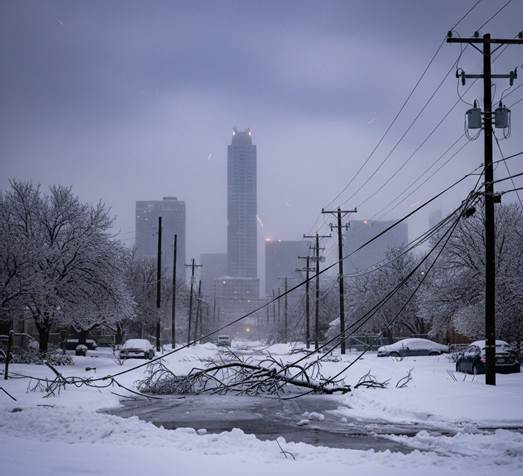
Five years ago, Winter Storm Uri (“Uri”) swept across Texas, which brought unusually severe cold, snow, and ice to areas unaccustomed to prolonged sub-freezing conditions. Persisting through much of the week, the storm resulted in historic low temperatures, with many areas seeing nights in the single digits or below. The result of the storm was not just record-breaking temperatures, but one of the most widespread power crises in Texas history.
By February 14, millions of Texans were without electricity and, in many cases, running water. Surveys conducted in the aftermath found that approximately 69% of Texans lost electrical power and nearly half experienced loss of running water as pipes froze and infrastructure issues arose. The loss of power and water led to an estimated 246 deaths throughout the state.[1]
The failure of the Texas power grid stemmed from a number of factors. At the height of the storm, electric demand increased rapidly as homes and businesses turned up heaters to compensate for the low temperatures. The Electric Reliability Council of Texas (ERCOT), which manages about 90% of the state’s electrical load, saw demand spike to record winter peaks exceeding 69 gigawatt-hours.[2] The surge occurred while generation capacity plummeted, creating a deficit that forced ERCOT to implement rolling blackouts statewide to prevent a catastrophic grid collapse.
One of the most important lessons from Uri was that much of Texas’s energy infrastructure was not prepared for prolonged severe winter weather. Though some plants had adopted voluntary winterization practices after earlier cold events (including the 2011 freeze), many facilities either failed to winterize properly or implemented inadequate measures.[3] Texas’s grid relies heavily on natural gas, which accounted for roughly half of generation capacity prior to Uri. However, the storm’s extreme temperatures also damaged natural gas infrastructure. Frozen wellheads, failed processing equipment, and lack of power at supply facilities led to significant drops in gas production and delivery, which in turn crippled gas-fired power plants.[4]
Reports after Uri found that ERCOT underestimated peak winter demand by a significant margin, meaning there wasn’t enough reserve capacity to meet the spike in load.[2] Combined with misjudged weather forecasts about the storm’s severity and timing, these planning failures worsened the crisis.
As a result of Uri, public outrage and regulatory pressure prompted a comprehensive reexamination of ERCOT and the rules that govern it. Policymakers, regulators, and industry stakeholders pursued a number of reforms aimed at preventing a repeat of the 2021 disaster. The 87th Texas Legislature passed a series of bills that significantly altered the governance and oversight of ERCOT and the state’s energy system. Key reforms included the following two senate bills:
- Senate Bill 2: Restructured the ERCOT board, reducing its size and requiring a majority of members to be appointed through a selection committee. It also strengthened oversight by the Public Utility Commission of Texas (PUC).[5]
- Senate Bill 3: Mandated weatherization requirements for generation, transmission, and fuel facilities and empowered regulators to fine entities that fail to comply.[6]
Under new rules developed by the PUC and enforced through ERCOT, generators and critical infrastructure must now weatherize equipment to handle extreme cold. Weatherizing includes insulating or shielding turbines, valves, and other equipment that previously froze and failed.[7] ERCOT and state officials also pursued market changes to incentivize reliability and capacity investment. The changes have included:
- Modifying governance rules to improve planning and responsiveness.
- Implementing reliability requirements that enable grid operators to more effectively manage supply shortfalls.
Although the reforms since Uri are meaningful progress, there are still challenges that remain for prevention of a similar incident from occurring in the future. Growth in electricity demand, resulting from population increases and emerging large users including data centers and industrial facilities, continues to put pressure on the grid.[8]
Since then, ERCOT and Texas regulators have taken substantial steps to address the deficiencies revealed by the storm, including strengthening weatherization rules, overhauling governance, reforming markets, and investing in reliability.[9] The grid improvements have helped to prevent similar occurrences in subsequent years, but the improvements must continuously evolve to meet future challenges.
Contact R.E.M. Risk Consultants today to learn more about our services and how our experts can assist in protecting your facility from climate hazards. For more information, visit our website at www.remrisk.com. Together, we can ensure a safer future for our communities.
[1] Svitek, P. (2022, January 3). Texas winter storm official death toll now put at 246. The Texas Tribune. https://www.texastribune.org/2022/01/02/texas-winter-storm-final-death-toll-246/.
[2] Douglas, E. (2021, February 16). Texas Power Outage: Why Natural Gas went down during the winter storm. The Texas Tribune. https://www.texastribune.org/2021/02/16/natural-gas-power-storm/.
[3] Gold, R. (2022, January 18). The Texas Electric Grid Failure was a warm-up. Texas Monthly. https://www.texasmonthly.com/news-politics/texas-electric-grid-failure-warm-up/.
[4] Scott. (2025, November 25). Lessons from 2021 winter storm uri for the August 2023 heat wave in Texas. Stillwater Associates. https://stillwaterassociates.com/lessons-from-2021-winter-storm-uri-for-the-august-2023-heat-wave-in-texas/.
[5] Relating to the governance of the Public Utility Commission of Texas, the Office of Public Utility Counsel, and an independent organization certified to manage a power region, TX SB2, 87th Cong. (2021). https://legiscan.com/TX/bill/SB2/2021.
[6] Relating to preparing for, preventing, and responding to weather emergencies and power outages; increasing the amount of administrative and civil penalties, TX SB3, 87th Cong. (2021). https://legiscan.com/TX/bill/SB3/2021.
[7] Patel, M. (2023, February 16). Public Utilities Commission of Texas Adopts New Winter Weatherization Rules in Response to Winter Storm Uri. Renewable + Law. https://www.lawofrenewableenergy.com/2021/11/articles/states/texas/public-utilities-commission-of-texas-adopts-new-winter-weatherization-rules-in-response-to-winter-storm-uri/.
[8] Guo, K. (2025, February 13). Texas’ Energy Demand May Exceed Supply in 2026, But Experts Caution Against Panic. The Texas Tribune. https://www.texastribune.org/2025/02/13/texas-power-grid-ercot-energy-forecast/.
[9] Boms, M. (n.d.). Four Years After Winter Storm Uri, States Can Learn from the Texas Energy Deployment Playbook. https://blog.advancedenergyunited.org/winter-storm-uri-states-can-learn-from-texas.